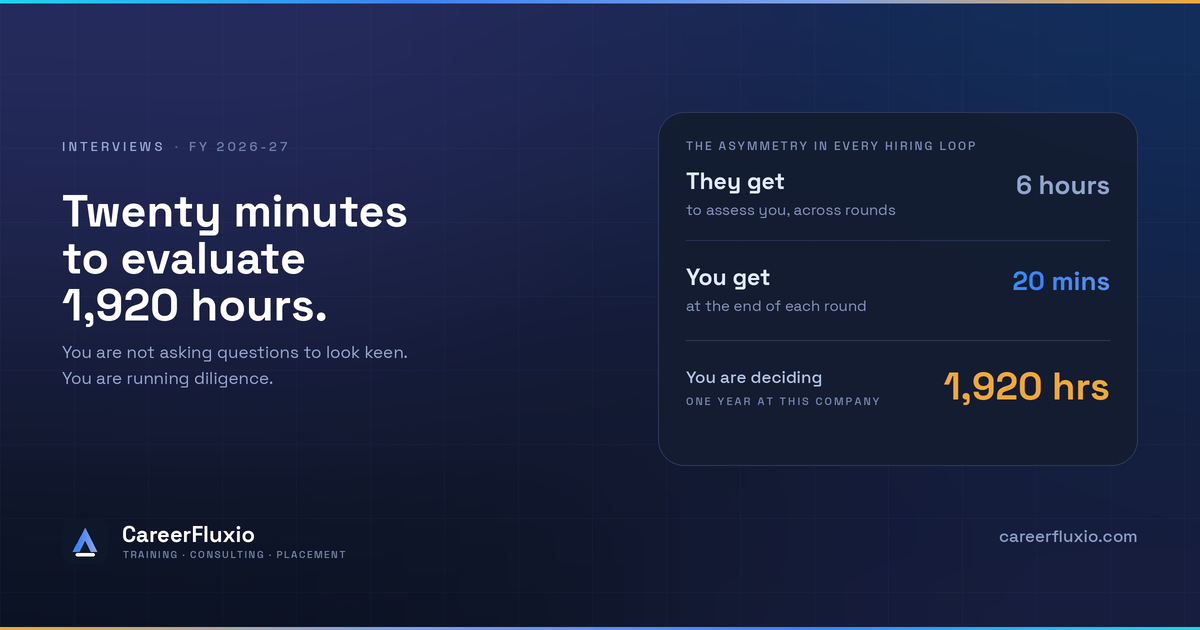
A company will spend around six hours assessing you across four rounds. You get roughly five minutes at the end of each one, so about twenty minutes in total, to assess them. What you are deciding with those twenty minutes is where you will spend about 1,920 hours next year; eight hours a day, five days a week, forty-eight weeks. Most candidates spend the time asking questions designed to look interested.
The short version: your questions are diligence, not enthusiasm signalling. Ask for instances rather than policies, because instances cannot be answered with a slogan. Five facts matter more than anything on the job description: why the role is open, how long the manager has been there, who left the team in the last year, what the actual weekly rhythm looks like, and how the band and review cycle work. Ask for one conversation with a peer before you accept.
Why "what does success look like in this role?" wastes your turn
It is the most commonly recommended question and it is nearly worthless, because it can be answered fluently by someone who has never thought about the role. You get a paragraph about impact and ownership, everyone nods, and you learn nothing you could not have guessed.
The same applies to the whole family: what's the culture like, how do you support growth, what are the biggest challenges. Every one has a socially correct answer that any competent manager can produce without reflection. Questions to ask the interviewer are only useful when a vague answer is visibly vague; when the absence of specifics is itself the information.
The fix is a grammatical one. Do not ask what happens. Ask about the last time it happened.
Instead of Ask
How do you handle work-life When was the last time someone on this
balance? team worked a weekend, and what caused it?
Do you invest in learning? What did the last person on this team
learn on the job, and how?
Is the codebase in good shape? What's the thing about the codebase
you'd warn me about in month one?
How is feedback given? What feedback did you give someone on
this team recently, and how did it land?
Is the roadmap stable? How many times has this quarter's
priority list changed since January?
A specific question has only two possible outcomes, and both are useful. Either you get a real answer, which is data. Or you get an evasion, which is also data.
The five facts you need before you can accept
Everything else is optional. These are not.
1. Why is this role open? Growth, backfill, or a new function nobody has owned before. A backfill means you should ask, straightforwardly, why the last person left; and a hiring manager who cannot answer that comfortably has told you something. A brand-new function means you will spend your first six months building consent for the role's existence, which is a real job that not everybody wants.
2. How long has the hiring manager been in the seat? Ask it plainly. You are joining a manager more than a company, and if they arrived three months ago, the role you are being described may not survive their first reorganisation.
3. Who has left this team in the last twelve months, and how large is the team? The team attrition question feels bold and is entirely reasonable to ask. Three departures from a team of eight in a year is the single most predictive fact you can learn in an interview, and it is one you will never find out later without asking now.
4. What does a normal week actually look like? Release cadence, on-call rotation, meeting load, how often plans change. Ask for last week specifically, not the ideal week. "Walk me through your last week" is one of the highest-yield questions available to you.
5. How does the band and review cycle work? Where this role sits in the band, when the next review is, and whether increments are calendar-based or anniversary-based. Someone joining in February at a company with an April cycle needs to know that before signing, not after.
The reverse reference check
The most under-used move in Indian hiring: ask to speak with someone who would be your peer, for fifteen minutes, without their manager present.
"Before I accept, could I have a short conversation with someone who'd be on the team with me? Fifteen minutes is plenty."
Companies verify your references as a matter of routine. Asking to verify theirs is symmetric and reasonable, and good employers say yes readily; some offer it unprompted. A refusal is not automatically damning, since some companies have policies about it, but the manner of the refusal tells you a lot.
When you get the call, do not ask whether they like working there. Ask what surprised them in their first month, what they would change, and what the last stressful week was caused by. Peers answer honestly in ways interviewers structurally cannot.
Reading the answers
The answer matters less than its specificity. Vagueness where specificity should be easy is the signal.
What you hear What it usually means
"We're like a family" Boundaries are weak; overtime is
social rather than compensated
"We move fast, things change" Roadmap instability; ask how many
times priorities changed this quarter
"The last person wasn't a good fit" Ask what the mismatch was. A specific
answer is fine; a vague one is not
"We're still defining the role" You will build the role. Fine if you
want that, costly if you expected clarity
"Compensation is competitive" Nothing. Ask for the band
"I'd have to check on that" (about the team) A manager who does not know their own
attrition is not close to the team
Red flags that are actually red
Plenty of things candidates panic about are noise. A rescheduled interview is noise. A slightly disorganised process is noise, especially at a startup. An interviewer who has clearly not read your résumé is mildly rude and not predictive.
These are the ones that are predictive, and all of them are visible before you sign:
- Nobody can tell you why the last person left. Either they do not know or they will not say. Both are problems.
- The role's scope changes between rounds. You are being interviewed for a gap rather than a job.
- Pressure to accept inside 24 hours. Real offers survive a weekend. Urgency is used to prevent diligence, and it is the single most reliable interview red flag in the list.
- Refusal to put anything in writing. Remote arrangements, band, title, review date. Verbal commitments do not survive a manager change.
- Every interviewer describes a different job. The team has not agreed on what they are hiring for, which means your first year will be spent negotiating it.
- Attrition they will not quantify. See above.
Ask the right person the right thing
Each round can answer a different set, and asking HR about the codebase wastes your five minutes.
The recruiter owns process and money. Ask about the band, the number of rounds, who you will meet, the timeline, and the review cycle. This is also the right place for questions to ask in the HR round about leave, notice period, and joining formalities.
The hiring manager owns the role. Ask why it is open, what the first ninety days look like, how they will judge whether the hire worked, what they would warn you about, and how decisions get made when the team disagrees.
The peer round owns reality. Ask about last week, what surprised them, what they would change, and what the team complains about.
The skip-level or leadership round owns direction. Ask how this team's work connects to what the company is betting on, and what would have to be true in two years for this team to be considered a success. Their answer tells you whether the team is central or peripheral, which decides your budget, your headcount and your visibility.
The two questions not to ask
Anything you could have found on their website. Asking what the company does is not curiosity; it is unpreparedness with a question mark on the end.
Anything phrased to flatter. Interviewers can tell the difference between a question you want answered and a question you are performing. The second kind costs you credibility, and it costs you one of your twenty minutes.
Write them down before you walk in
The failure mode is not asking badly. It is being asked "any questions for us?" at minute fifty-four of an intense conversation and reaching for whatever is nearest. Write four questions per round on paper, ask two or three, and keep one in reserve for the next round.
If you want these rehearsed under pressure, our interview preparation mock rounds are scored on the same rubric hiring panels use, including how candidates handle the reverse questioning. And once an offer lands, our placement desk reads it with you before you sign including the terms that only matter on the way out.
Frequently asked questions
What are the best questions to ask at the end of an interview?
Ask why the role is open, how long the manager has been in the seat, who has left the team in the past year, what last week actually looked like, and how the band and review cycle work. Those five decide more about your next year than anything in the job description.
Is it rude to ask about attrition or why the last person left?
No, and it is standard diligence. Ask it neutrally "was this a backfill or a new role?" and let the answer come. Discomfort in the response is itself informative.
Can I ask about salary in the interview?
Ask the recruiter about the band early, since that is their remit and it saves everyone time. Avoid opening the number with the hiring manager mid-process; the compensation conversation belongs with whoever controls the band.
How many questions should I ask?
Two or three per round, asked well, with follow-ups. A list of eight recited quickly reads as a script and leaves no room for the follow-up, which is where the actual information lives.
What if the interviewer gives vague answers to everything?
Treat consistent vagueness on easy specifics as your answer. A manager who cannot say what last week looked like either is not close to the work or does not want to describe it.
Should I ask for a conversation with a future teammate?
Yes, before accepting. Fifteen minutes with a peer, without their manager, is the highest-yield diligence available to a candidate, and good employers agree to it without friction.