Your promotion is discussed in a room you are not in. So is the decision about who leads the next project, who gets the interesting work, and who is quietly considered senior. In every one of those rooms, the evidence about you is not your work. It is the description of your work, a document you wrote, or somebody else's summary of something you failed to write clearly.
The short version: writing is the only skill that multiplies every other skill you have, because your work is invisible until it is described. Five documents carry most of your professional reputation: the status update, the bug report, the design proposal, the escalation and the handover. Fix those five and you will be read as more senior than you were last quarter, without learning anything new about your craft.
Why writing outranks the skill you are currently practising
Three mechanisms, none of them about eloquence.
Distance. The people who decide about you are two or three steps from your work. They do not see the debugging session; they see the update. If the update is muddy, the work is assumed muddy, which is unfair and entirely predictable.
Asynchrony. Distributed teams and offshore delivery mean most of your professional communication happens without you in the room to clarify. A document that needs a follow-up call has failed at the only job it had.
Durability. Speech evaporates and documents circulate. The design note you wrote in March gets forwarded in September to someone who has never met you, and it argues your case without you. This is why workplace writing skills compound in a way that tooling knowledge does not; one is an asset that keeps working, the other depreciates with the version number.
The one test that fixes most writing
Before you send anything, ask: can the reader act on this without replying to ask a question?
That is the whole test. It is not about grammar or vocabulary. Every reply that says "what do you mean by…", "which environment?", "so what do you need from me?" is a failure you can measure. Most professional writing problems in India and everywhere else are not English problems, they are missing-information problems; an ask with no owner, a status with no number, a decision with no date.
The five documents that carry your reputation
1. The status update
Before: "Working on the payment module. Facing some issues with the third-party API. Will update."
After: "Payment module is 70% done, on track for Friday. Blocked on sandbox credentials from the vendor: I've chased twice, no response since Tuesday. If we don't have them by Wednesday, Friday slips to Monday. Can you escalate through the vendor manager?"
The second version is barely longer and does four things the first does not: quantifies progress, names the blocker, states the consequence with a date, and makes one specific ask of one person. A status update template worth using has exactly those four slots.
2. The bug report
Before: "Login is not working on staging. Please check urgently."
After: "Login fails on staging for users with SSO enabled. Steps: open /login, enter an SSO email, submit request returns 500. Expected: redirect to the identity provider. Started after yesterday's 4pm deploy; the previous build works. Trace and request ID attached. Not reproducible for password users."
A developer can start on the second one immediately. The first generates three messages before work begins. A bug report template needs steps, expected versus actual, when it started, scope, and evidence; and leaving any of them out transfers your work onto someone else.
3. The design proposal
The document that most changes how senior you are considered, and the one most people never write. Structure it as: the problem in one paragraph, the options you considered, the option you recommend, the trade-off you are accepting, and what you would need to reverse the decision. Two pages is plenty.
The section that does the work is the trade-off. Anybody can advocate. Naming what your recommendation costs is what makes readers trust the recommendation and it is the same instinct that makes a portfolio project credible, which we covered in what reviewers actually check.
4. The escalation
Before: "I have raised this multiple times but nothing is happening. This is very frustrating and will impact the delivery."
After: "Raising this to you because it needs a decision above my level. The QA environment has been down since 4 August. I've raised three tickets, most recent one attached. Regression testing for the 22 August release cannot start until it's up, so the release date is at risk from 15 August. I need either the environment restored by the 14th or agreement to move the release date."
The escalation email rule: escalate the decision, not the emotion. State the facts with dates, name the consequence, and offer the two options you can live with. Frustration in writing reads as a problem you have, not a problem you found.
5. The handover
Nobody reads their own handover doc again, which is why they are usually terrible. Write it for the person who joins after you leave and cannot ask you anything: what runs where, what breaks routinely and how to fix it, who to call, what you were about to do next, and what you would change if you had another month. A good handover is remembered long after the work is forgotten.
Six rules that do most of the work
- Decision first. Put the conclusion in the first sentence and the reasoning after. Readers who need only the conclusion stop; readers who need the argument continue. Burying the point is a courtesy to nobody.
- One ask per message. Two asks means one gets ignored, and you will not know which.
- Attach a number. "Slow" is an opinion. "1.8 seconds against a 400ms budget" is a fact somebody can act on.
- Kill the hedge stack. "I think we might possibly want to perhaps consider" is one hedge repeated five times. Pick one "I think we should" and keep it.
- Name the owner and the date. An action item without both is a wish.
- Cut every sentence over about 25 words in half. Long sentences are where ambiguity hides, and short sentences read as confidence.
What unclear writing actually costs
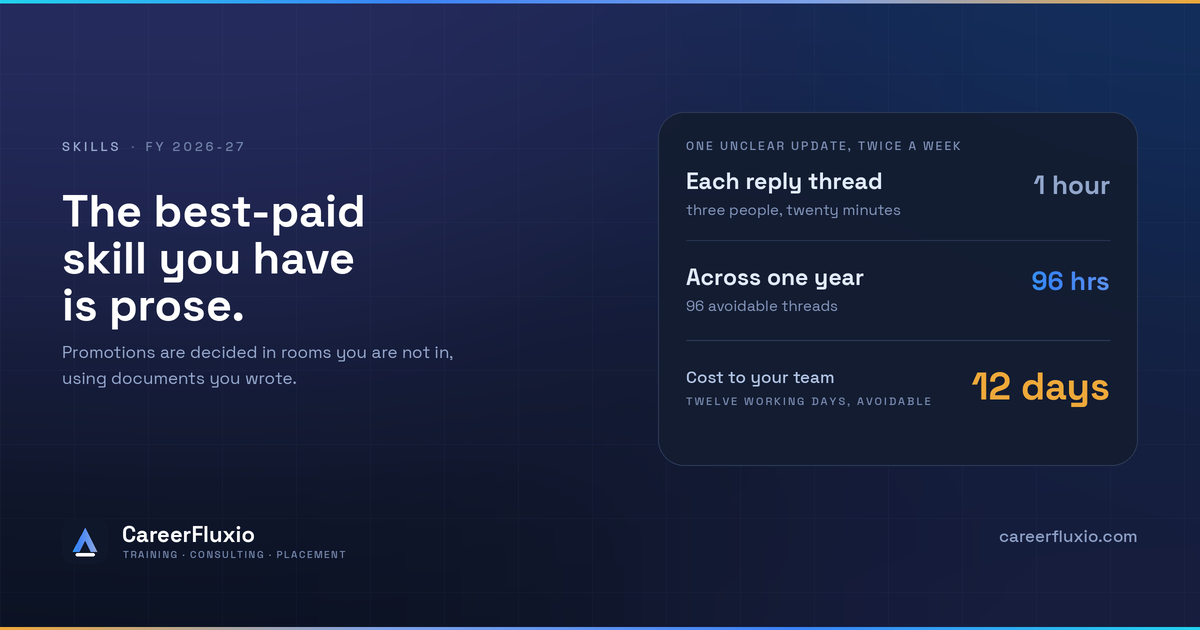
Say one update a week is unclear enough to generate a clarifying thread, and one bug report a week is too. Each thread pulls three people for twenty minutes. That is one hour of team time per thread, 96 threads a year, and 96 hours — twelve working days of your team's time, spent on questions your first draft could have answered.
That number is why the strongest engineers on any team are usually not the fastest coders. They are the ones whose messages do not generate threads.
If English is your second language
Most professional writing advice ignores this, which is unhelpful in a country where most people work in their second or third language. Three practical points.
Short sentences are an advantage, not a limitation. Simple structures read as confident and are harder to misread. Chasing complex sentence construction is the main cause of unclear professional writing in English, including among native speakers.
Formal register is not the same as clear. Reaching for elaborate phrasing "kindly do the needful at the earliest", "please find the same attached" adds distance without adding information. The reader still does not know what to do. Replace the flourish with the ask: "Please approve the invoice by Thursday."
Read your draft aloud once. It catches more than any grammar tool, because sentences that are hard to say are usually hard to read. This is the highest-return thirty seconds available to anyone improving professional communication.
A thirty-day practice plan
You do not need a course. You need reps with feedback, which is what deliberate practice means in this domain.
- Week 1. Rewrite every status update using the four slots: progress with a number, the blocker, the consequence with a date, the single ask.
- Week 2. Apply the reply test to everything before sending. When someone does reply asking for clarification, save the exchange; that is your error log.
- Week 3. Write one design proposal for something you are already doing. Two pages, including the trade-off. Share it even if nobody asked.
- Week 4. Reread your error log from week 2 and find the pattern. It is almost always one of three things: the ask was missing, the date was missing, or the conclusion was buried.
Then keep the habit. This is the rare skill where the practice and the job are the same activity, which is why it is the cheapest thing on your list to improve and why it belongs near the top of the tally when you decide which skill to learn next.
The same clarity is what carries an interview answer, incidentally. Our interview preparation rounds score how candidates structure an explanation, not just whether the answer is right.
Frequently asked questions
How do I improve communication skills at work quickly?
Apply one test to everything you send: can the reader act without replying to ask a question? Then fix the three things that usually fail it; a missing ask, a missing date, and a conclusion buried in paragraph three.
Do soft skills really matter more than technical skills for IT professionals?
Not more, but they are the multiplier. Technical depth determines what you can do; writing determines whether the people deciding about you know you did it.
How long should a status update be?
Four sentences in most cases: progress with a number, the blocker, the consequence with a date, and one ask. If it runs longer, you are probably reporting activity instead of status.
What is the difference between a status update and activity reporting?
Activity reporting lists what you did. A status update tells the reader what changed, what is at risk, and what you need. Managers need the second and are usually sent the first.
Should I write long emails or short ones?
As short as the content permits, with the conclusion first. Length is not the problem; burying the point is. A two-page design document with the recommendation in the first line is easier to read than a five-line email whose ask is in the last sentence.
How do I write an escalation without sounding like I am complaining?
State facts with dates, name the consequence to the business, and offer the two options you can live with. Escalate the decision rather than the frustration, and copy the minimum number of people who can actually act.